
Table of contents
- The Page Was Never the Hard Part
- The Product Thesis in Plain Language
- What an Agent Can Do With ezValidate
- The Four Parts of the Validation Rig
- Market Identification Is Part of Validation
- Demand Does Not Only Live Online
- Not Every Signup Means the Same Thing
- Who Needs This Most
- We Built It for Ourselves First
The Page Was Never the Hard Part
We had a familiar problem inside Cavendo Studios: too many ideas and too much friction between “this might be useful” and “let’s see if anyone actually wants it.”
Building a landing page had become fast. The rest had not.
For every concept, we still had to choose a hosting path, deploy the page, connect a domain, wire up a form, decide where submissions should go, configure email delivery, add analytics, create source tags, find the audience, learn the rules of each community, write the outreach, and somehow keep the results organized.
None of that was the real question. The real question was whether the concept deserved more time.
So we built ezValidate: a simple system an agent can use to deploy a demand-test page, identify plausible audiences, prepare appropriate messaging, track online and offline sources, and help a person read the result.
The first working version went from specification to a live system on May 5, 2026. Within roughly a day, we were running real concepts through it.
The Product Thesis in Plain Language
I have a domain name or an idea. I want to point it to a page, collect a real signal, and decide what to do next.
That sounds simple because it should be simple.
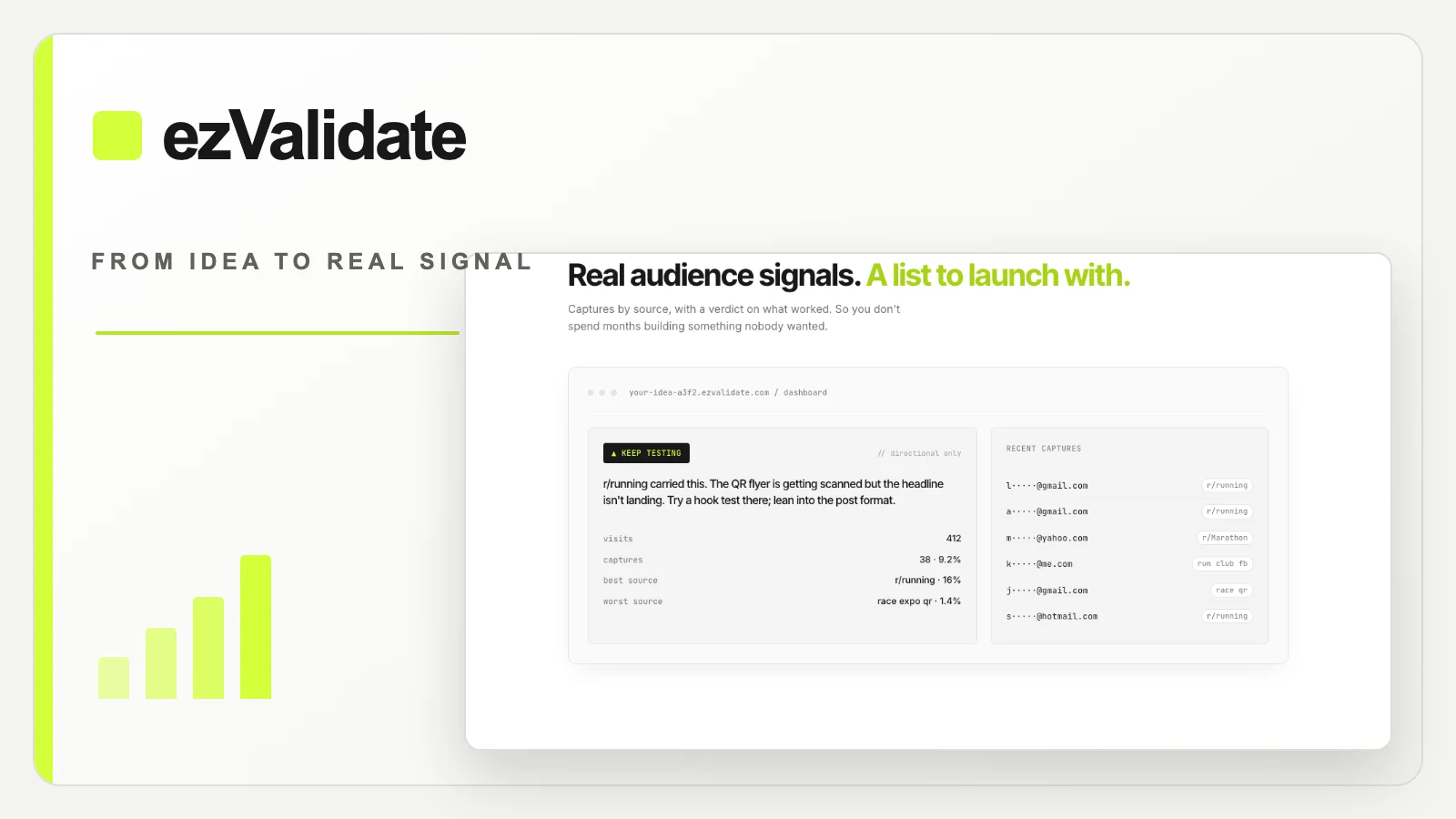
ezValidate collapses the plumbing into one working surface. Each concept gets its own page, audience plan, outreach material, source-aware analytics, captures, and decision history. The concept does not disappear into a spreadsheet or an old chat thread when attention moves elsewhere.
We think of that as first-signal infrastructure: the system between having an idea and making a larger investment in building, hiring, inventory, a lease, or a campaign.
What an Agent Can Do With ezValidate
The useful workflow begins with a conversation, not a page builder.
- Define the test. The agent turns the idea into a specific audience, promise, action, and decision threshold.
- Prepare the landing page. It can write or refine the page and submit the deployable HTML or project package.
- Deploy the test. ezValidate hosts the page on a project URL or configured domain and wires the capture and source attribution into it.
- Identify the market. The Audience Atlas helps the agent find communities, newsletters, local surfaces, and other places where the relevant people already gather.
- Adapt the message. The agent drafts outreach around the culture and rules of each surface rather than blasting one generic launch announcement everywhere.
- Create offline material. For local tests, the workflow can prepare flyers and QR codes whose tagged links identify the venue or campaign that produced each visit.
- Read the signal. Visits, captures, sources, and conversations become a recommendation to continue, change the hook, try a different audience, or stop.
The agent handles the coordination and repetitive work. The person decides what may be published, which communities are appropriate, how much evidence is enough, and whether the idea moves forward.
The Four Parts of the Validation Rig
1. Page Rig
Bring a page built with your preferred tool. ezValidate deploys it, connects the form, records visits and captures, supports a project subdomain or approved custom domain, and gives the test a stable home.
2. Audience Atlas
The Atlas is organized around audience families—the kinds of people who gather together—not a rigid list of product categories. It records where an audience can be reached, why the concept may matter there, how self-promotion is treated, where a link belongs, what language to avoid, what signal to expect, and how to attribute the response.
3. Source Attribution
Online links can use source slugs or campaign parameters. Offline material can use a QR code tied to a particular venue, flyer, event, or neighborhood. The dashboard can then distinguish a Reddit discussion from a newsletter click or a scan at a local library.
4. Signal Reader
The useful answer is not merely “the page converted at 4%.” It is closer to: “The parent group produced fewer visits but more serious signups. The broad social post produced traffic but no intent. Test a narrower neighborhood message next.”

Market Identification Is Part of Validation
A weak response does not always mean a weak idea. It can mean the test reached the wrong people, used the wrong framing, or violated the norms of the community where it appeared.
That is why ezValidate does not treat distribution as a list of places to paste a link. An audience entry has to answer practical questions:

- Where do these people already gather?
- Why would they care about this problem?
- How can someone participate without being treated as spam?
- Should the link appear in the post, a comment, a profile, a direct message, or nowhere?
- What language or behavior should be avoided?
- Should success look like clicks, replies, direct messages, QR scans, signups, calls, or deposits?
- How will that signal be attributed?
An agent can help research candidate subreddits, industry forums, Facebook groups, newsletters, associations, local venues, events, and creator communities. It can then prepare surface-specific drafts for human review.
ezValidate is not an automated posting bot. Community rules and human judgment matter. The system helps identify and prepare appropriate tests; it should not impersonate people, evade moderation, or flood communities with links.
Demand Does Not Only Live Online
The QR workflow exists because some of the best tests happen in physical places.
Imagine testing a calm indoor play space for young children. The useful audience might be reached through a local parent group, but it might also be reached at library story time, a pediatrician’s office, a children’s boutique, a preschool, or a neighborhood coffee shop.
An agent can generate a flyer sized for printing, create the QR code, and use a tagged URL for each venue. ezValidate then reports which placement produced scans and which scans produced a meaningful response.
| Concept | Possible audience surfaces | Useful signal |
|---|---|---|
| Local service or venue | Neighborhood groups, libraries, local newsletters, venue-specific QR flyers | Location plus signup, call, or booking |
| B2B software | Industry communities, professional associations, targeted outreach, practitioner newsletters | Qualified signup, reply, or discovery call |
| Course, book, or community | Creator audiences, topical forums, newsletters, events | Email, social handle, or preorder interest |
| Agency recommendation | Client audience, paid test, partner channel, existing customer segment | Evidence that de-risks the proposed build |
Not Every Signup Means the Same Thing
Email is a natural starting point because it is familiar and relatively low-friction. It is not the only possible signal.
Depending on the question, a project may care more about a phone number, ZIP code, social handle, calendar booking, application, or refundable deposit. Each step asks the visitor to commit more and therefore changes how the result should be interpreted.
visit → email → phone or location → booking → depositA lower conversion rate on a high-intent action can be more meaningful than a large email list. The test has to match the decision being made.
Who Needs This Most
A determined founder with one product, strong marketing instincts, and time to assemble hosting, forms, analytics, and outreach manually may not need ezValidate.
The value becomes clearer for:
- Portfolio builders testing several concepts without rebuilding the validation stack each time
- Agencies and consultants that want evidence before recommending a larger client investment
- Product teams that need demand proof before requesting engineering budget
- Local operators testing a neighborhood, service area, class, event, or physical location
- Newer builders who may mistake a poor distribution attempt for proof that nobody wants the idea
The common thread is not “people who need a landing page.” It is people whose next month could be wasted building, hiring, leasing, or promoting the wrong thing.
We Built It for Ourselves First
The first test for any Cavendo Studios product is whether we keep using it after the excitement of building it wears off.
ezValidate began as a control panel for our own portfolio. Each idea got a page, an audience, a set of drafts, source-aware results, and a verdict. We could leave a concept alone, return later, and see the state of the test without reconstructing it from deployment logs, spreadsheets, and old conversations.
That was the immediate win. The broader product opportunity came second.
AI made it dramatically easier to build something. ezValidate is our attempt to make it easier to learn whether that thing should be built at all.
Explore ezValidate or see the other products we are building through Cavendo Studios.
Share this article

Jonathan Arehart
Founder at Cavendo. In 2000, I started Cavendo building websites. Today, we build practical AI and software systems that help businesses work smarter.